


GREEN ACRES COTTAGE, Asheville, N.C. — Sunday, August 23
A child does not experience government as a hierarchy.
It takes shape in the name above the schoolhouse door, the books in the library, the history a teacher is permitted to teach and the school board members who decide whether every child belongs.
In Shenandoah County, Virginia, six people recently sat in six chairs and voted unanimously to continue defending the Confederate names of two public schools.
Most Americans will never know who those six officials are. Their decision is unlikely to determine control of Congress.
But try telling a Black child entering one of those schools that what those six officials did was “down-ballot.”
Six chairs in Shenandoah County
In 2024, the Shenandoah County School Board voted to restore the names of Confederate military leaders to two public schools.
The Virginia NAACP, students and their families challenged that decision in federal court.
On Aug. 6, U.S. District Judge Michael Urbanski ruled that the board had discriminated against Black students, violating the Equal Protection Clause of the 14th Amendment and the Equal Educational Opportunities Act. He ordered the district to replace the Confederate names through a nondiscriminatory process.
One week later, the six members of the school board voted unanimously to appeal that decision.
Six locally elected officials committed their county to extending a legal fight over whether Black children can be required to attend public schools named for men who fought to preserve slavery.
That is political power—and we ignore it at our peril.
It is the power to determine what children see above the entrance to their school. It is the power to decide which history a community honors. It is the power to commit public resources to defending that choice in court.
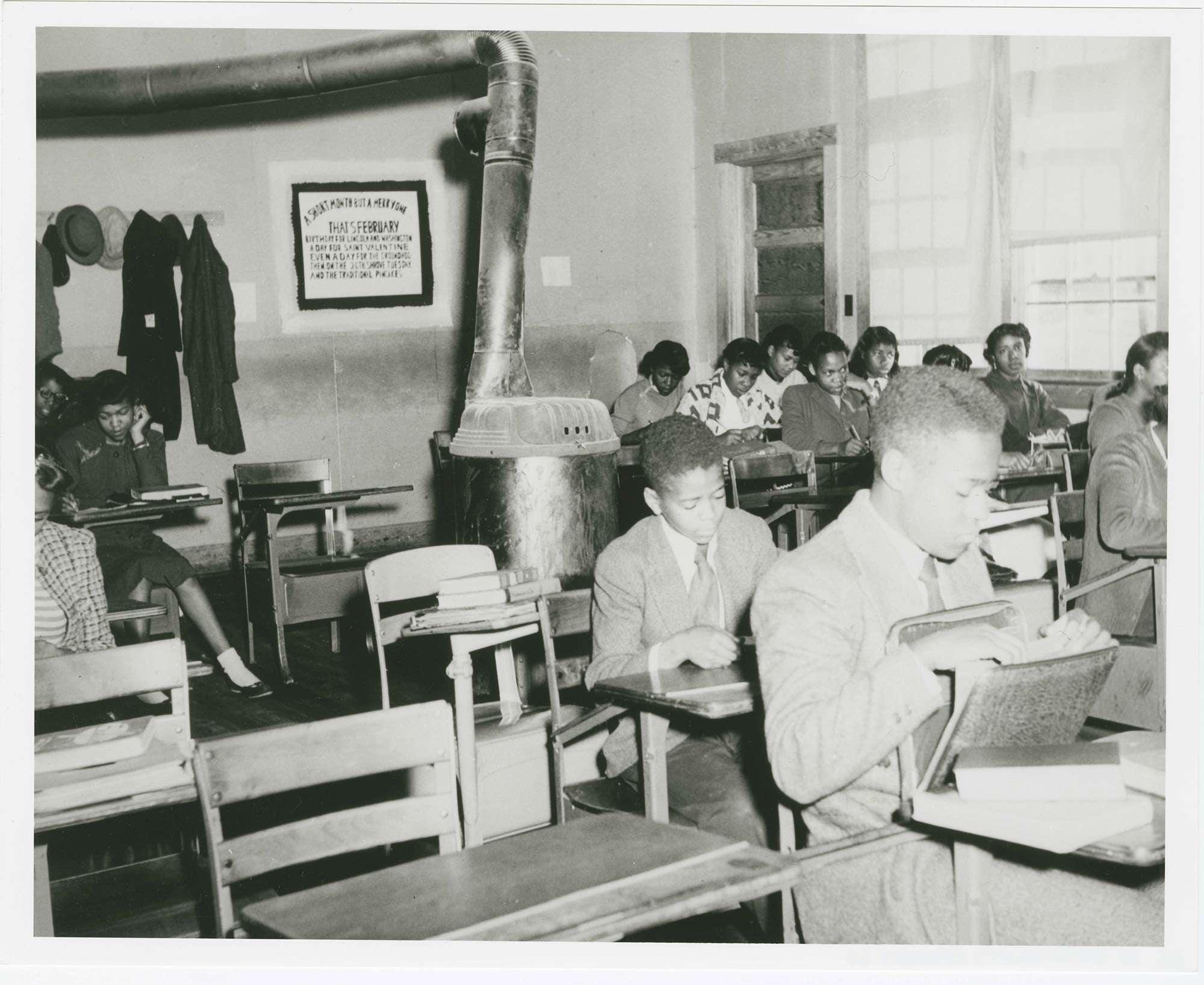
Students inside Robert Russa Moton High School in Farmville, Virginia, 1951. A student strike against the unequal conditions provided by the local school board led to Davis v. County School Board, one of the cases decided with Brown v. Board of Education.
Photo: National Archives.
Brown v. Board of Education did not begin in the marble halls of Washington. In Virginia, it began when a 16-year-old student named Barbara Johns decided she had endured enough of the overcrowded classrooms and tar-paper buildings her local school board provided for Black students.
She led her classmates out on strike. Students and parents went to court. A conflict with one county school board traveled all the way to the Supreme Court and helped establish a constitutional principle for the entire country.
Sometimes power begins in a classroom, rises through a county courthouse and reaches the Supreme Court.
But a Supreme Court ruling does not enforce itself.
During Virginia’s Massive Resistance to school desegregation, Dr. William Ferguson “Fergie” Reid co-founded the Richmond Crusade for Voters. It registered Black voters, organized get-out-the-vote drives and built political power precinct by precinct. In 1967, Reid became the first African American elected to the Virginia General Assembly since Reconstruction.
That legacy continues through his son, Fergie Reid Jr., whose work registering voters, recruiting candidates and supporting Democrats in difficult districts I have written about before.
The work of democracy must move across generations.
More than 40,000 offices
Labor Day is still two weeks away, but the 2026 campaign has already entered its final sprint.
Most political coverage will spend the next 10 weeks asking whether Democrats can retake the House or Senate and whether a blue wave is building.
But this coverage describes only a fraction of what voters will decide on Nov. 3.
BallotReady estimates that more than 40,000 federal, state and local seats will be on the ballot that day. Congress accounts for fewer than 500 of them.
The rest will determine who sits in school board meetings and county courthouses: people who will adopt budgets, decide how land is used, prosecute crimes, oversee elections and determine which communities receive public investment.
This November, 6,139 state legislative seats are scheduled for election across 46 states. Those legislators will draw political maps, regulate voting, fund public education, determine access to health care and decide how much authority local communities are allowed to exercise.
I have spent much of my working life in and around campaigns. I have seen what happens when all the attention, money and organizing capacity flow upward.
Communities are visited for a campaign and then forgotten. Potential candidates are overlooked or put on hold. Local offices are left uncontested because everyone is waiting for a national wave to solve what has been neglected closer to home.
The ballot is not an organizational chart. The offices near the bottom do not report to the offices at the top.
Sometimes change begins with citizens challenging local power. Sometimes it begins with a local official choosing to exercise that power differently.
From a county counter to the White House
In March 1975, two men walked into the Boulder County clerk’s office and asked for a marriage license.
Clela Rorex had been elected clerk only months earlier. She was 31 years old. After consulting the assistant district attorney and learning that Colorado law did not expressly prohibit two people of the same sex from marrying, she issued the license and subsequently issued five more.
Forty years before Obergefell v. Hodges, an elected county clerk put the power of her local office on the side of equality.
The arc from that county counter to the White House glowing in rainbow colors on June 26, 2015, was not inevitable. It was built by couples who demanded recognition, lawyers who brought their cases, organizers who changed public opinion, legislators who voted and local officials who decided that their offices could be instruments of dignity rather than exclusion.
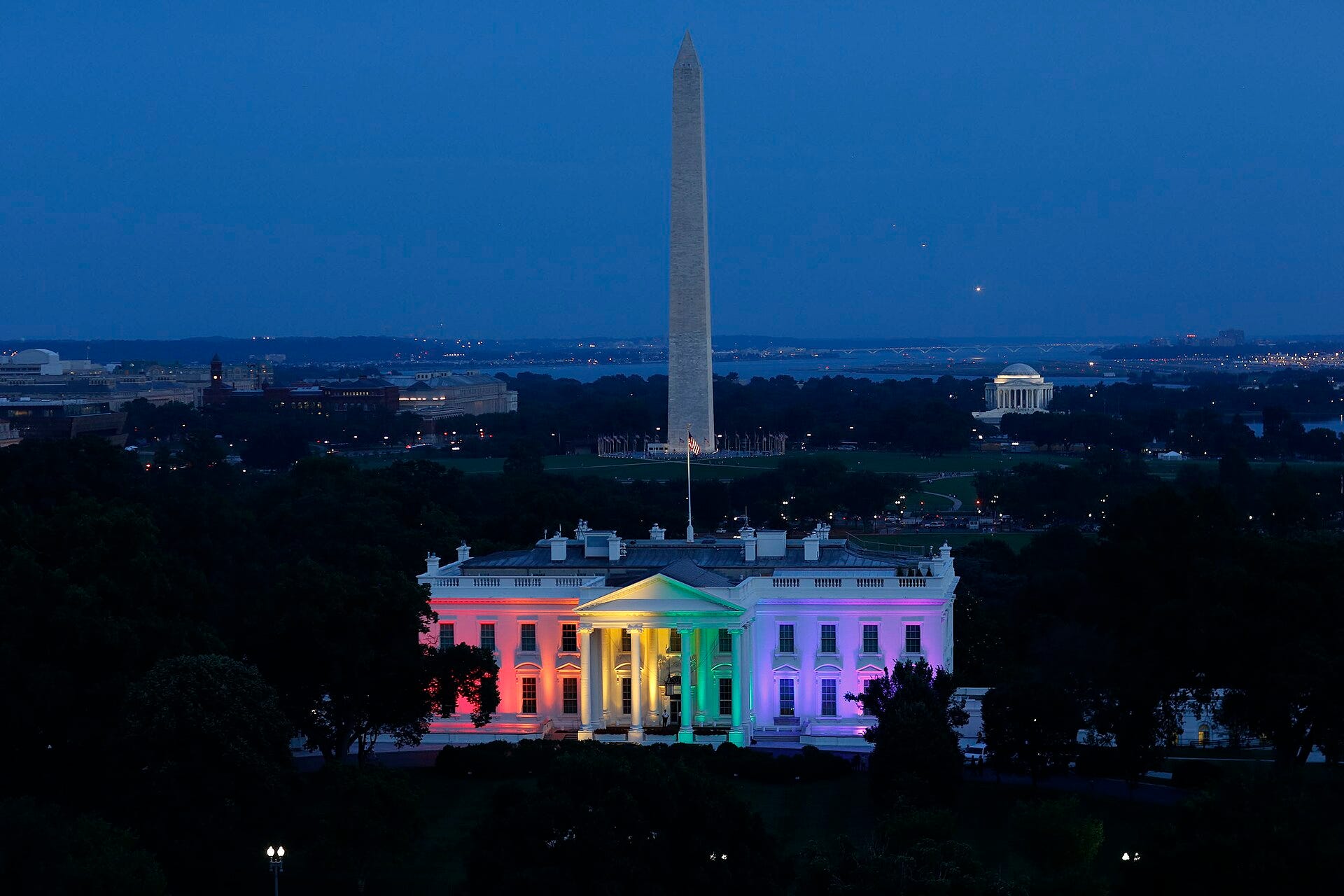
The White House illuminated in rainbow colors on June 26, 2015, after the Supreme Court recognized marriage equality nationwide.
Official White House photo by Chuck Kennedy.
But victories do not become permanent simply because the White House changes color. Obergefell remains law, but Dobbs showed that Supreme Court precedent can be withdrawn.
Recent Supreme Court decisions have allowed states to restrict access to transition-related medical care for transgender young people and exclude transgender girls from girls’ school sports. These are not abstract legal changes. They determine which children receive care, which students are permitted to belong and which families can still rely on the promise of equal protection.
Power moves in both directions.
A right can begin at a county counter, become national law and then return to state legislatures, school boards, courthouses and county offices to be defended or denied.
Rights are not won once. They must be defended at every level that can interpret, enforce, weaken or repeal them.
A blue wave that crests in Washington but never reaches school boards, courthouses, statehouses and county commissions leaves much of American political power untouched.
That is why competing everywhere matters. We cannot concede power before a vote is cast.
Someone said yes
Blue Florida is working around the clock to recruit more Democratic candidates to ensure that Republican candidates for Congress and the Florida Legislature no longer routinely receive a free pass.
Blue Florida does not assume every candidate will win immediately. Its premise is more fundamental: Voters deserve a choice, and political power should never be surrendered without a contest.
That principle is embodied by candidates such as Wendy Hoy, the Democratic candidate for Florida House District 57.
Hoy is a former teacher, a former single mother and a grandmother of four. She has worked in home health and hospice education, directed Head Start centers, served as an assisted-living administrator and advocated for children as a guardian ad litem.
Her life has placed her beside families during some of their hardest moments. Now she is asking those families to trust her with political power.
No one can promise Hoy’s race will be easy. But she said yes. Her candidacy gives volunteers doors to knock on, neighbors a reason to talk and voters a different choice. It is a refusal to concede.
Two election clocks
Right now, Democrats need to operate on two clocks.
The first is counting down.
Barely 10 weeks remain before Election Day. Candidates need money, volunteers, organizers and people willing to make calls, knock on doors and talk to their neighbors. Local party organizations need to turn databases and campaign plans into human contact.
But another clock is already counting forward.
On Nov. 2, 2027, Virginia will elect all 40 members of its state Senate and all 100 members of its House of Delegates. Voters will also choose sheriffs, treasurers, commonwealth’s attorneys, and commissioners of revenue, along with county supervisors and school board members across Virginia.
In 2027, New Jersey will elect all 120 members of its Legislature.
Louisiana and Mississippi will elect their state legislatures and statewide officials.
Thousands of municipal, county and judicial offices will also be decided around the country.
The strongest candidates in those elections should not be receiving their first phone calls urging them to run in the summer of 2027. They should be identified now. They should be building relationships now.
Potential campaign managers should be learning their communities now. Volunteers should be given reasons to return after November. County organizations should be preserving what they learn this year instead of allowing that knowledge to disappear when campaign offices close.
That is the principle behind the 3,100 County Challenge: Invest $10,000 to $15,000 annually in every county Democratic organization for the next 25 years, not for television ads, consultants or polling, but for candidate recruitment, volunteer training, local communications and a year-round community presence.
We cannot ask county Democrats to compete for every office while tying one hand behind their backs and hobbling one leg. Competing everywhere requires capacity everywhere.
While campaigns count down to the next election, durable organizations must also count forward.
That is the argument running through these essays.
Candidate recruitment, volunteer development, local infrastructure and governing power are not separate projects.
We recruit candidates because offices carry power. We build organizations because candidates cannot compete alone.
We invest in volunteers because relationships create trust. We preserve what campaigns learn because Election Day should leave a community stronger than it found it.
Who will occupy the chairs?
Election Day 2026 will come and go. Votes will be counted. Pundits will pivot to 2028. Campaign offices will close, clipboards will be put away and yard signs will disappear.
But the school board will still meet.
So will the county commission, the state legislature, the city council and the court.
Budgets will be adopted. Books will be approved or removed. Maps will be drawn. Laws will be enforced. Appeals will be filed. Decisions will be made about schools, roads, housing, health care, elections and civil rights.
Six people will sit down again around a table in Shenandoah County. Thousands more will take their seats in communities across the country.
The question is not whether those decisions will be made.
The question is who will be sitting in those chairs when they are.
Power is on the ballot.
P.S.
This November, don’t stop at the top of the ballot.
Find out who is running for your school board, county commission, city council, state legislature and local courts. Learn what authority those offices carry and whether voters have a real choice.
If someone has stepped forward to contest a difficult race, volunteer, share their campaign or contribute what you can. If an office is uncontested, ask your county Democratic organization what it will take to recruit a candidate next time.
Below is my growing list of organizations and candidates doing the local, long-term work required to compete for political power.
In Virginia, please consider supporting:
In Florida:
In Texas:
In Indiana:
Nationally:
State Innovation Exchange (working with progressive state legislators to move a Democratic agenda forward)
Rural Organizing (progressives building community change in rural communities)
Barn Raising Media/Barn Raiser (Independent journalism for Rural America)
Continue the conversation
Are you doing this work or know someone who is? I want to hear your story.
Across America, people are quietly strengthening local Democratic organizations, often with little recognition and even fewer resources. I want to spotlight their work in these weekly essays.
Reach me at david.phelps2015@gmail.com
— David
About me
I’m David Phelps, a writer, communications strategist, and a laborer in the fields for the Democratic Party. I live with my three rescue dogs, two groundhogs, and a sleuth of black bears, in Asheville, North Carolina.
Over the course of my career, I’ve worked for the Democratic National Committee, and with Senator Edward M. Kennedy, Special Olympics International, campaigns at all levels, advocacy organizations and nonprofit leaders committed to strengthening civic life.
Today, I’m highlighting the people, relationships, and local Democratic Party institutions quietly sustaining American democracy, one county, one story, and one conversation at a time.
Australian by birth. American by choice.
If you believe empowering local Democrats means a stronger Democratic Party, I’d be honored to have your ongoing support as a free or paid subscriber.
Thanks for highlighting how attentive we must be to ALL levels of government. We in Shenandoah County VA are not letting up about our School Board's obscenity of appealing to retain Confederate names AFTER they had been removed in 2020. Our schools are falling apart, we can't keep teachers, yet the SB intends to spend up to tens of millions of OUR money to defend THEIR Confederate Cult Culture war. Every race, every vote matters.